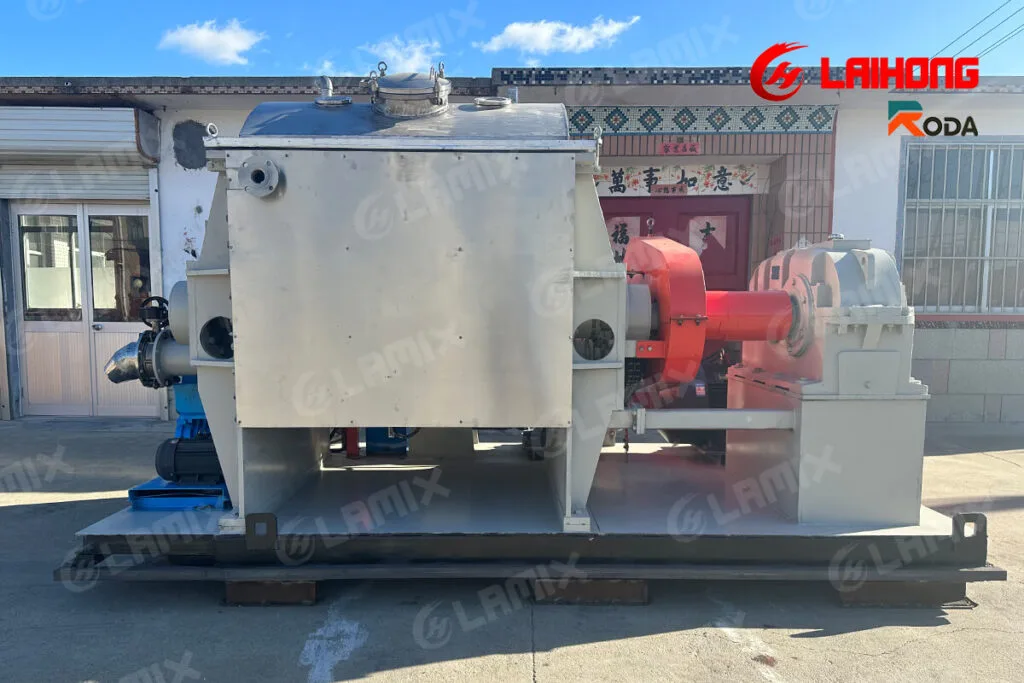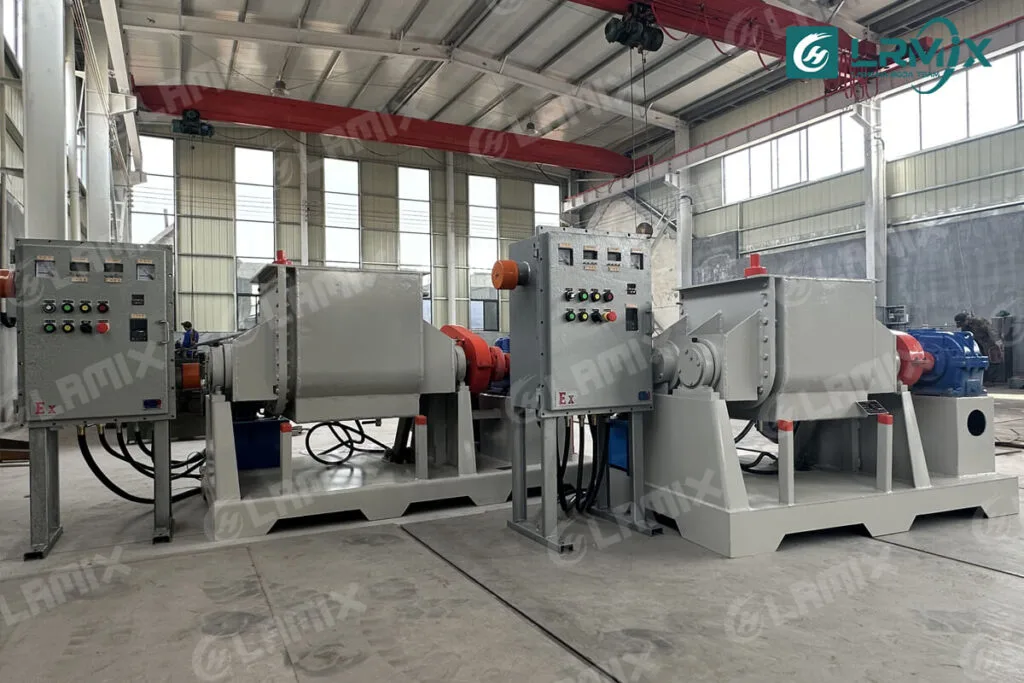
Walk onto the shop floor at Shandong Laihong Machinery’s plant and the first thing you notice isn’t the noise — it’s the row of half-finished disperser frames lined up for final assembly, each one waiting on its motor, its disc, or its hydraulic cylinder before it ships out.
This is where LRMIX’s high-speed dispersers actually come from. Not a trading company repackaging someone else’s steel, but a 4,000 m² factory in Shandong Province that’s been building mixing equipment since 2006. Two decades in, the product line has grown into six major series — sigma kneaders, ribbon blenders, planetary mixers, multi-shaft mixers, plastic recycling machines, and the high-speed dispersers pictured on this page — shipped to customers in more than 40 countries.
What’s Actually on the Floor
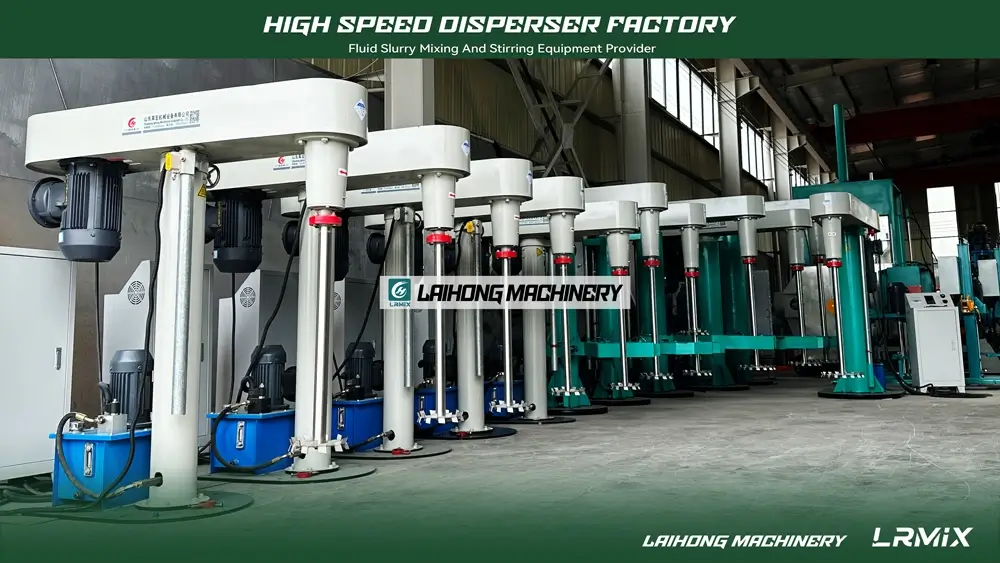
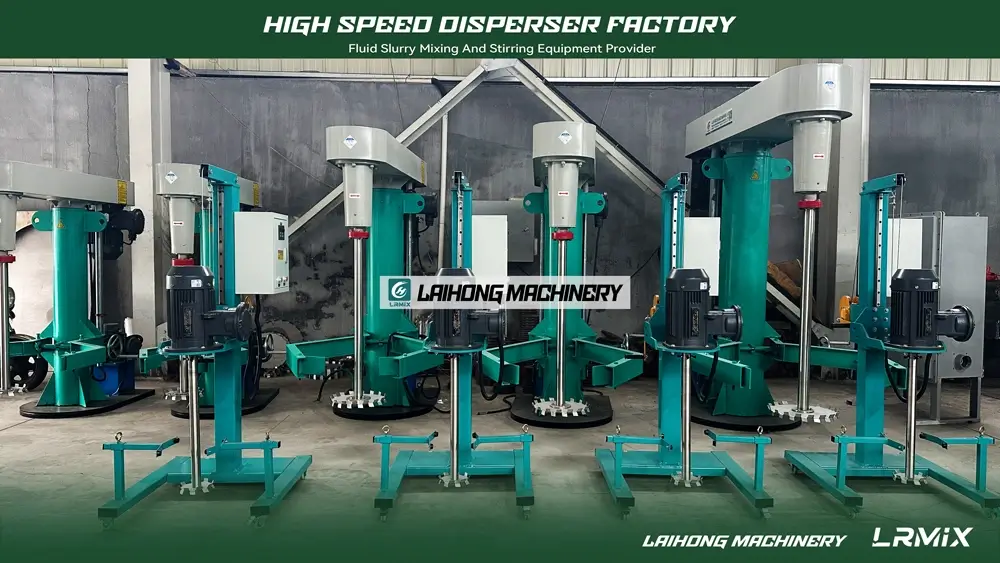
The photos above aren’t stock images. They’re taken during assembly and testing, showing the GFJ-series hydraulic lifting dispersers side by side with a smaller bench-scale unit — the same range customers see when they visit in person or join a video call with the engineering team.
The LGF series covers a wide spread: from a 3–4 kW lab model with a 150–200 mm dispersion disc, up through 45 kW+ units built for 1,000–2,500 liter batches. Every version shares the same core design — a 304 stainless steel shaft, a European-standard synchronous double-layer shear disc, and a hydraulic lifting frame driven by a high-pressure engineering cylinder rather than a manual winch. Speed regulation runs 0–1450 rpm or 0–2880 rpm depending on configuration, with linear tip speeds over 20 m/s for the higher-power models — enough to break down pigment agglomerates and pull powder into liquid quickly instead of over several passes.
Electrical components come from Delixi or Schneider, with travel-switch limiters on the lifting mechanism as a standard safety feature rather than an optional extra. Clamping is available in manual, pneumatic or electric versions depending on how often the tank needs to be swapped.
Why Factory-Direct Matters for This Equipment
Dispersers get customized more often than buyers expect — explosion-proof motors for solvent-based coatings, sealed designs for pharmaceutical use, dual-shaft combinations for higher-viscosity pastes, or a lifting-lid version for a tank that’s already fixed in place. Working directly with the factory that engineers these changes, rather than through a middleman, is usually the difference between a two-week lead time on a modification and a much longer back-and-forth.
That’s the practical case for buying from a source factory: the people answering your spec questions are the same ones who built the disc and the shaft.
Where These Machines End Up
LRMIX dispersers are used across coatings, paints, resins, adhesives, inks and pigments, and pharmaceutical formulations — anywhere a batch needs powder wetted into liquid and sheared down to a fine, stable dispersion before it moves on to a bead mill or into final packaging.
For a factory tour, technical drawings, or help matching a model to a specific viscosity and batch size, LRMIX’s engineering team can be reached directly via WhatsApp or email — no distributor markup, no guesswork on lead times.
LRMIX (Shandong Laihong Machinery Equipment Co., Ltd.)
WhatsApp: +86 198 1875 7839 | Email: info@lrmixer.com | lrmixer.com