Anyone who’s formulated paint or ink knows the moment pigment goes into the tank is far from the moment it’s ready to sell. Powder clumps, wetting is uneven, fineness falls short of spec — none of that gets fixed by simply stirring longer. It takes two different mechanical principles working in sequence, which is why most established production lines run a high-speed disperser paired with a horizontal sand mill, rather than expecting one machine to do it all.
Why One Machine Usually Isn’t Enough
The core of a high-speed disperser is a toothed disc. Spinning at high speed, it generates an intense turbulent zone within roughly 2.5–5 cm of its edge — material pulled into this zone experiences repeated shear and impact, quickly wetting powder and breaking up the larger clumps. But for applications demanding fine, uniform pigment distribution — high-hiding coatings, high-gloss inks — a disperser alone often can’t reach target fineness. It’s not that the equipment is inadequate; it’s a limitation built into the mechanism itself. Shear is concentrated near the disc, and material elsewhere in the tank never sees the same intensity.
That’s why the industry treats the disperser as a pre-treatment step: get the material wetted, break up the obvious clumps, then hand it off for fine processing.
Stage One: Pre-Mixing with a High-Speed Disperser
Take the LRMIX 45kW dual-shaft high-speed disperser as an example — 0–1450 RPM stepless variable speed, SUS304 shaft and disc, fully explosion-proof motor and control cabinet. That explosion-proof rating isn’t optional; it’s a hard safety requirement for solvent-based production lines. The dual-shaft configuration effectively doubles per-tank output, which matters a lot when a plant needs the pre-mix stage to keep pace with the grinding line downstream.
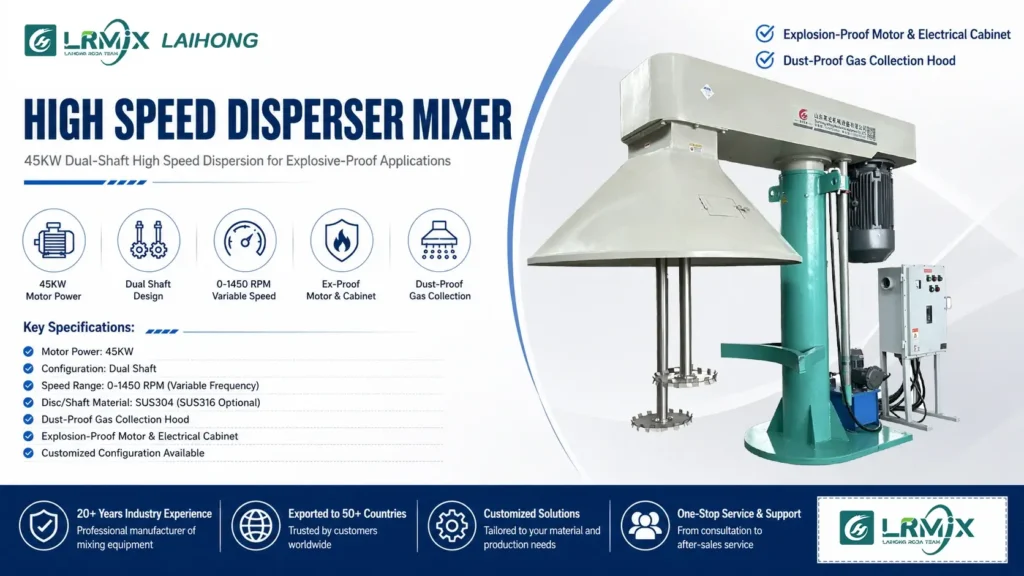
What this stage actually needs to accomplish is three things: fully wet the powder into the liquid phase, break up the visible agglomerates, and bring the slurry to a viscosity that pumps cleanly into the next process. It’s not chasing final fineness — it’s preparing the material for grinding.
Stage Two: Fine Grinding with a Horizontal Sand Mill
Once the pre-mixed slurry enters a horizontal sand mill, a completely different mechanism takes over. Grinding media — zirconia beads, zirconium silicate beads, or glass beads — driven by a high-speed rotor collide with pigment particles millions of times over, gradually reducing agglomerates to target particle size. The combination of rotor type (disc, pin, or turbine), lining material (zirconia ceramic, polyurethane, tungsten carbide, PTFE), and separation system (dynamic screen, gap separator, or centrifugal separation) largely determines whether a given mill can match your material and fineness target.
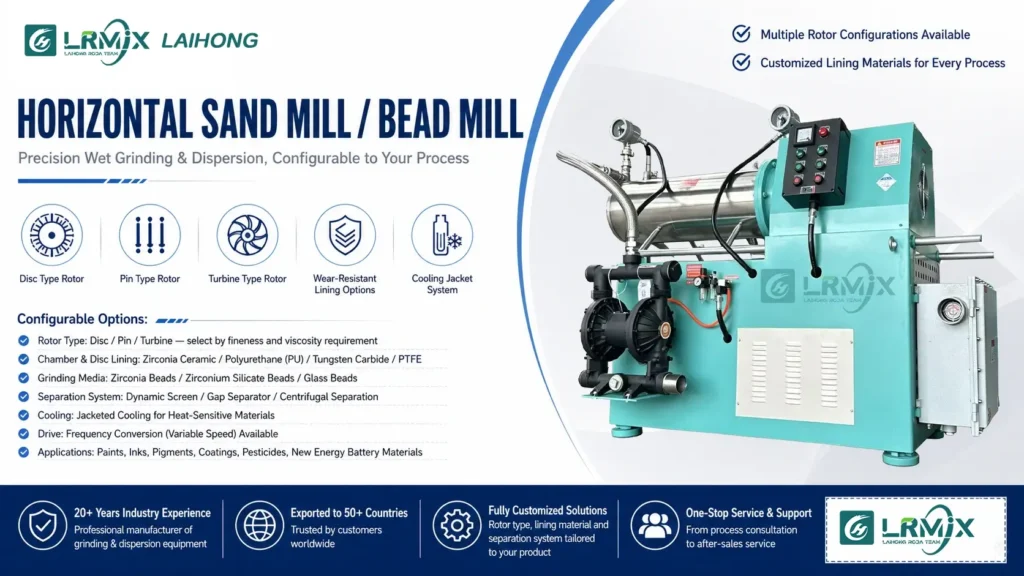
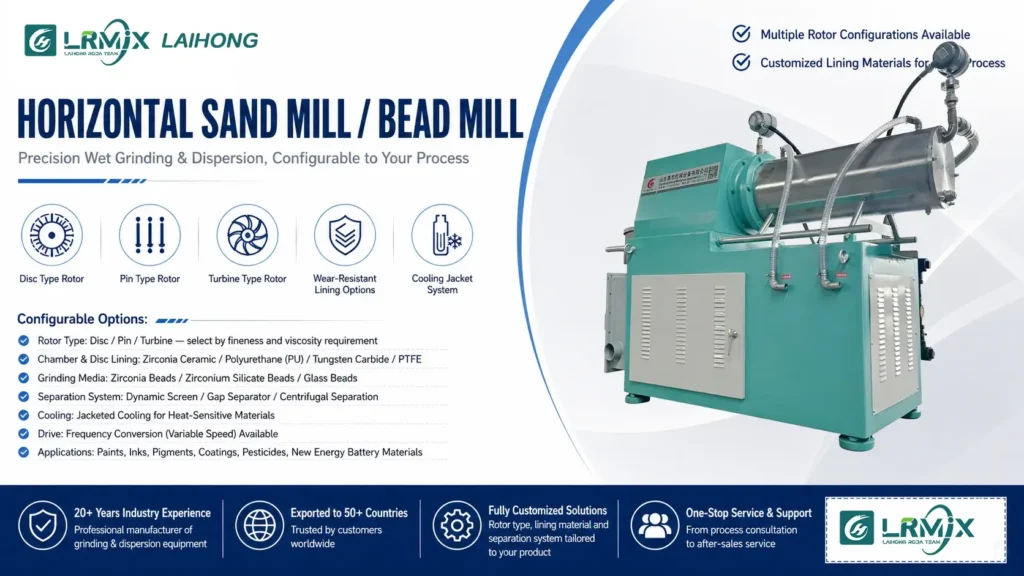
One detail that’s easy to overlook: grinding converts a lot of mechanical energy into heat. Without adequate cooling, rising temperature can shift viscosity sharply or cause localized gelling, undoing the dispersion that’s already been achieved. In continuous production, a jacketed cooling system isn’t a nice-to-have — it’s what keeps batches consistent.
How You Know It’s Ground Enough — Fineness Testing
The most common way to check dispersion and grinding progress is still the fineness-of-grind gauge — GB/T 1723 in China, corresponding internationally to ASTM D1210 and ISO 1524. The method is straightforward: material is drawn into the gauge’s tapered groove, a scraper pulls across it, and the point where particles visibly break the surface gives the fineness reading. Target fineness varies a lot by application — general architectural coatings might only need 25 microns, while premium color pastes or fine print inks often require 5 microns or finer.
What a Typical Two-Stage Line Looks Like
Raw material weighing and batching → pre-mix and wetting on the high-speed disperser → slurry transfer to the horizontal sand mill → fine grinding to target fineness → letdown and additive blending → filtration → filling. Throughput on the two machines has to be matched — otherwise the disperser sits idle waiting on tank space, or the mill backs up waiting on feed. That’s usually the first thing we ask about when a customer is sizing equipment: annual output, target fineness, and viscosity range. Get that mismatch wrong and the whole line’s efficiency suffers, regardless of how good either individual machine is.
A Few Things That Trip Up Real Production
Viscosity that’s too high restricts particle movement inside the grinding chamber and actually reduces efficiency while raising energy use. Media that’s too large won’t reach target fineness; too small, and it wears out fast and becomes hard to separate. Poor temperature control shows up as batch-to-batch inconsistency. None of these get solved by simply running more power through the motor — they need to be matched to the specific material system.
If you’re planning a paint, ink, or color paste line and need to size a disperser-and-sand-mill combination for your material and fineness target, our engineers are happy to review the specifics with you.