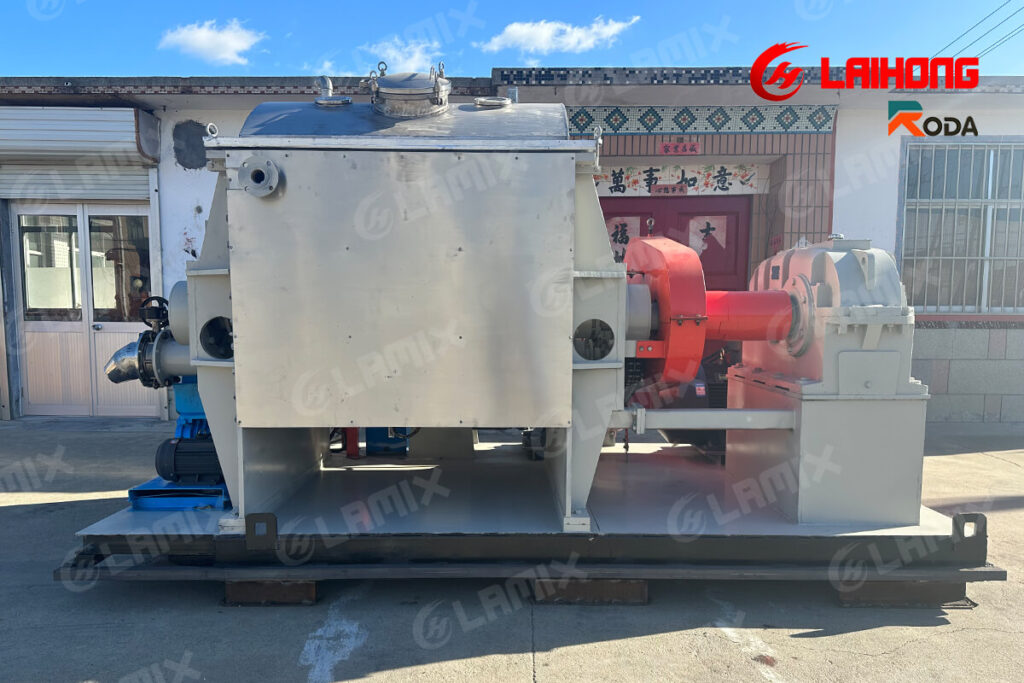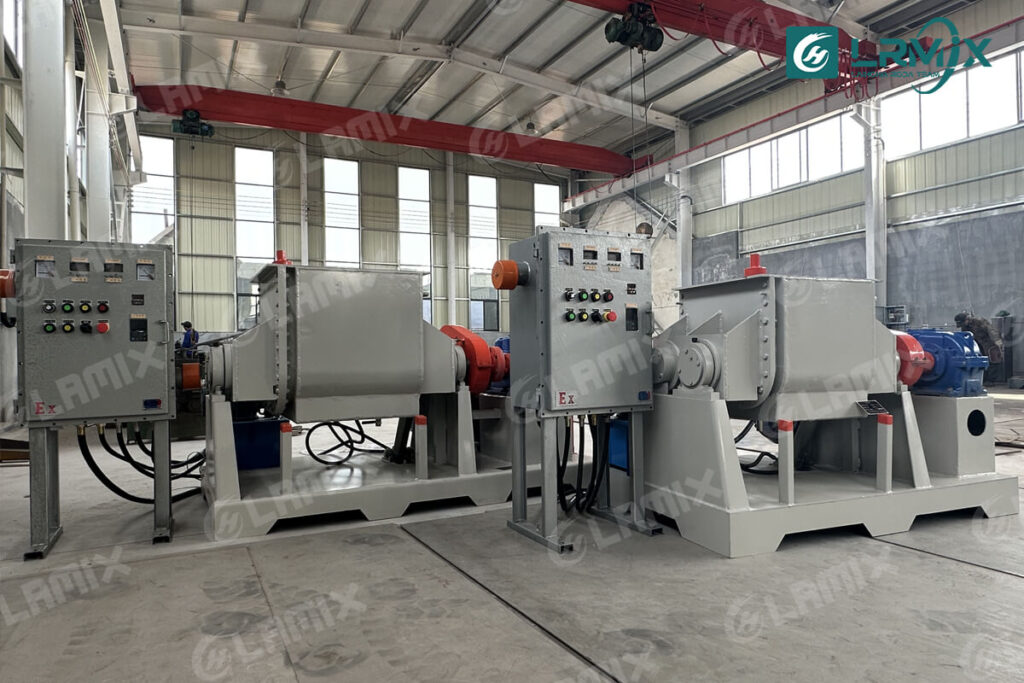
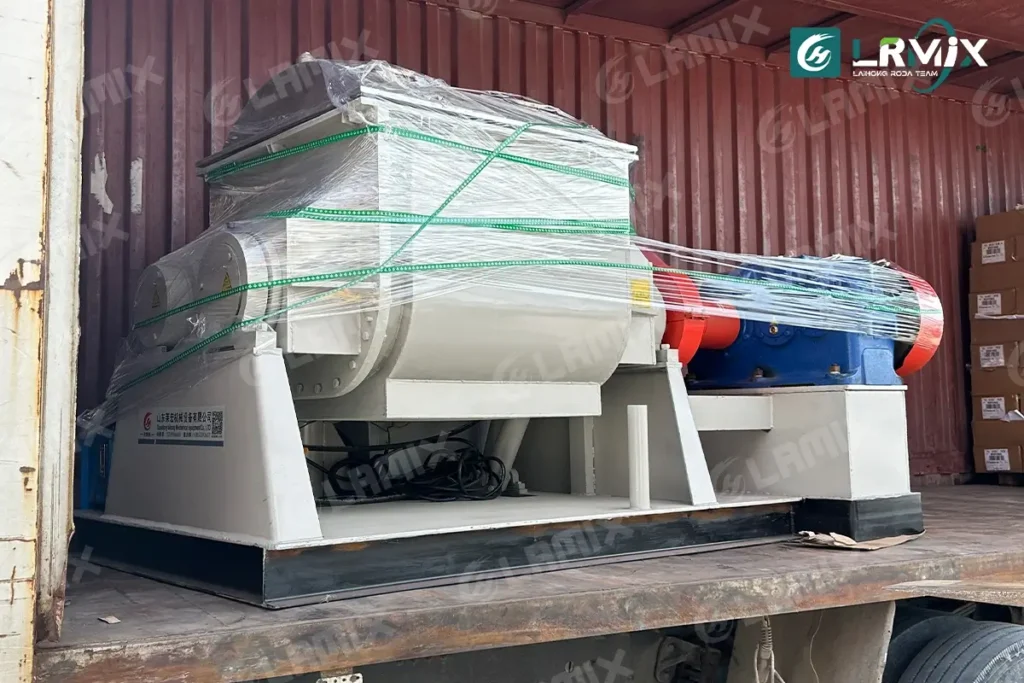
This week, a 500L sigma kneader completed final inspection at the LRMIX factory in Shandong and is ready for delivery. Using this build as a reference point, here is our practical guide to the six factors that determine whether a sigma kneader is correctly specified for your application.
After 15 years of manufacturing sigma kneaders for customers in 40+ countries, these are the questions that consistently separate a well-specified machine from a problematic one.
Factor 1: Working Volume — Not the Number on the Nameplate
The capacity figure printed on a machine specification is the nominal volume — not the volume you actually mix per batch. For high-viscosity materials, the working fill coefficient is 0.5–0.65. A 200L kneader processes 100–130L per batch, not 200L.
How to calculate what you need:
Required working volume (L) = Batch weight (kg) ÷ Material bulk density (kg/L) ÷ Fill coefficient (0.55)
Example: 100kg silicone rubber gum base per batch, bulk density 1.1 kg/L: → 100 ÷ 1.1 ÷ 0.55 = 165L working volume required → Select a 200L or 250L machine with comfortable headroom
Undersizing causes motor overload and blade stall. Oversizing causes poor mixing — material cannot reach the blades at low fill levels.
Factor 2: Material Viscosity — The Most Important Parameter
Viscosity determines motor power, blade speed ratio and gearbox specification. It is the single most critical selection parameter — and the one most commonly missing from buyer enquiries.
| Viscosity | Typical Materials | Configuration |
|---|---|---|
| 10,000 – 100,000 cP | Light adhesives, soft compounds | Standard sigma kneader |
| 100,000 – 500,000 cP | Silicone rubber, sealants, gum base | Heavy-duty, ZLY hard-tooth reducer |
| 500,000 – 2,000,000 cP | Structural adhesives, BMC/DMC | Reinforced, high-torque drive |
| Above 2,000,000 cP | Carbon electrode paste, stiff rubber | Custom engineering |
Always specify viscosity at your lowest processing temperature — this is the worst-case condition the machine must handle. If you are unsure of your material’s viscosity, request the data from your raw material supplier before contacting equipment manufacturers.
Factor 3: Discharge Method
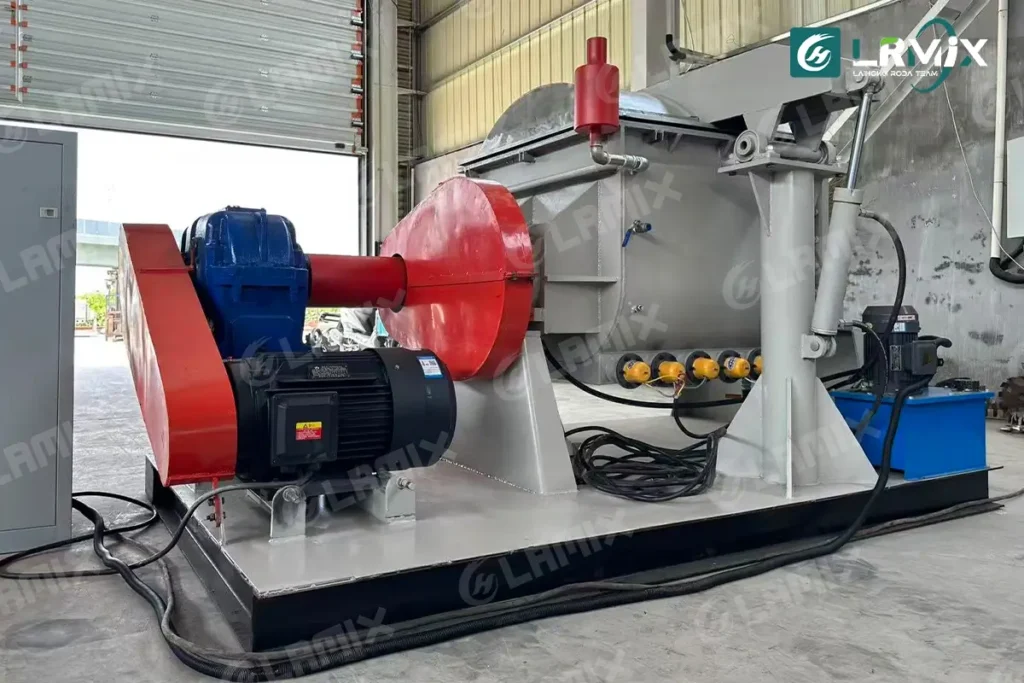
Hydraulic Tilt (130°) — Vessel tilts hydraulically, compound flows out under gravity. Discharge in 2–4 minutes. The standard choice for silicone rubber, adhesives, chewing gum and most general applications.
Screw Extrusion Discharge — Integrated screw extruder forces compound out continuously as strip or pellet. Feeds downstream calenders or extruders directly. Best for high-volume silicone rubber production lines.
Bottom Valve Discharge — Gravity discharge through a bottom valve. Suitable for lower-viscosity compounds with good flow.
The 500L unit in this delivery is configured with hydraulic tilt discharge — the customer’s production flow collects compound in batches for transfer to a calender line.
Factor 4: Heating and Cooling System
Define your temperature requirement before specifying the jacket:
Cooling only — For materials that generate heat during mixing and must stay below a maximum temperature throughout (silicone rubber with fumed silica, exothermic adhesives).
Heating only — For materials that require elevated processing temperature (hot-melt adhesives, gum base softening).
Heating + Cooling (dual-function) — The same jacket handles both phases within a single batch. Hot water from a mould temperature controller for warm-up; chilled water for cooling before temperature-sensitive additions. This is the correct specification for silicone rubber compounding and chewing gum production.
Heating options: hot water circulation (most controllable, up to 120°C), steam (up to 150°C), electric heating (no utilities required).
Factor 5: Vacuum System
Vacuum capability is essential for some applications and unnecessary for others. Specify it only if your process requires it.
You need vacuum if: — Your material entraps air during mixing that causes defects in the finished product — Your application requires void-free compound (medical silicone, food-contact products, optical applications, technical ceramics) — Your material contains volatiles that must be removed
You do not need vacuum if your material is not sensitive to air inclusion.
Standard specification: ≥ –0.09 MPa. This is sufficient for silicone rubber, ceramics and most pharmaceutical applications.
Factor 6: Gear Reducer — The Component Most Buyers Overlook
The gear reducer is the component most commonly underspecified in low-cost sigma kneaders — and the most common cause of premature equipment failure.
Soft-tooth (hobbed) reducers have gear surface hardness of HB 180–280. Hard-tooth (carburised and quenched) reducers — ZLY series — have surface hardness of HRC 58–62, with 40–60% higher load capacity at equivalent physical size.
For high-viscosity applications with peak torque loading — silicone rubber gum loading, adhesive compounding, ceramic clay preparation — ZLY hard-tooth face reducers are the correct specification. The 500L unit in this delivery is fitted with a ZLY reducer selected to handle the peak torque of the customer’s silicone rubber production.
If a supplier cannot confirm the reducer model number and service factor for your application, treat this as a warning sign.
The 6 Questions to Answer Before Requesting a Quote
Before contacting any sigma kneader manufacturer, have clear answers to these six questions:
- Required batch weight (kg) and material bulk density?
- Material viscosity at minimum processing temperature?
- Preferred discharge method?
- Temperature requirement — heating, cooling, or both?
- Is vacuum degassing required?
- Required production volume (batches per shift)?
With these answers, a competent manufacturer can provide an accurate specification and quotation. Without them, you will receive a generic price list that may not suit your application.
LRMIX manufactures sigma kneaders from 5L laboratory scale to 3,000L production capacity. Standard and custom configurations available — including explosion-proof, steam heating, electric heating and SS304/SS316L food-grade options.
WhatsApp: +86 198 1875 7839 Email: info@lrmixer.com Website: www.lrmixer.com
View LRMIX Sigma Kneader Range: https://lrmixer.com/product-category/sigma-mixer/ Silicone Rubber Application Guide: https://lrmixer.com/silicone-rubber-mixing/ Adhesive & Sealant Guide: https://lrmixer.com/adhesive-sealant-mixing/