In sigma kneader selection, most buyers focus on capacity, motor power and jacket specification. Discharge method — how the finished compound actually leaves the machine — is often the last consideration. For high-viscosity, sticky materials like silicone rubber compound and ceramic clay body, it is one of the most important.
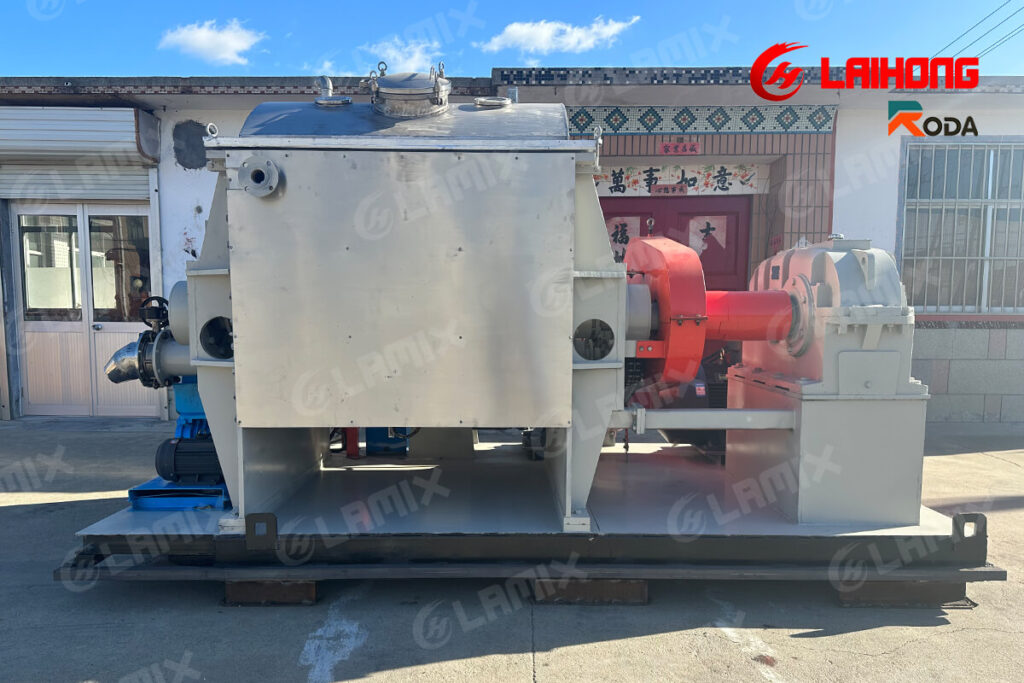
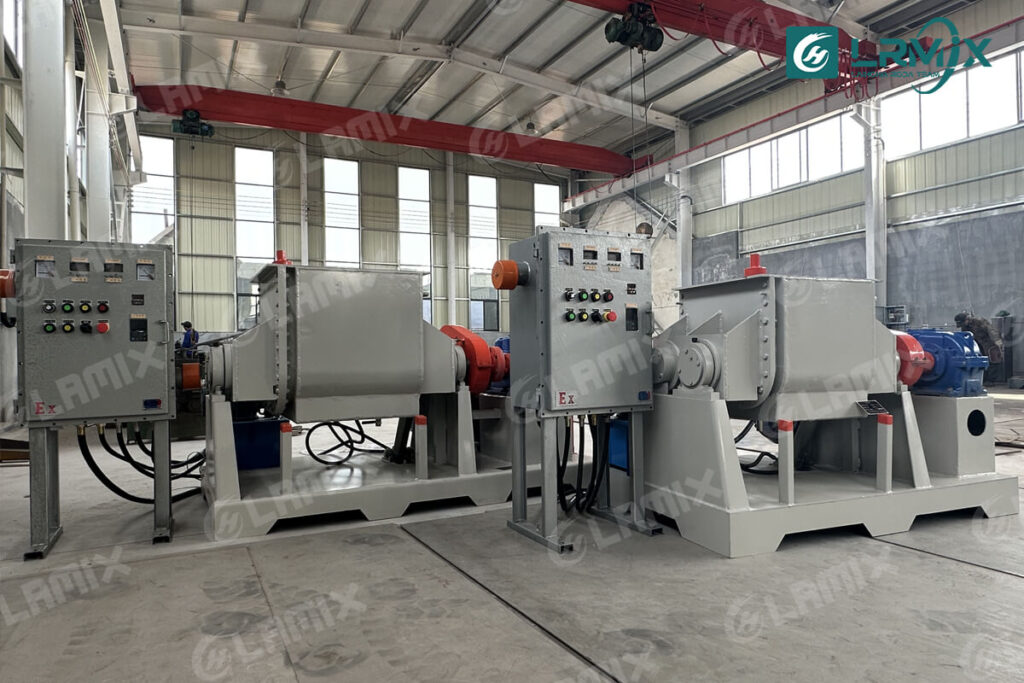
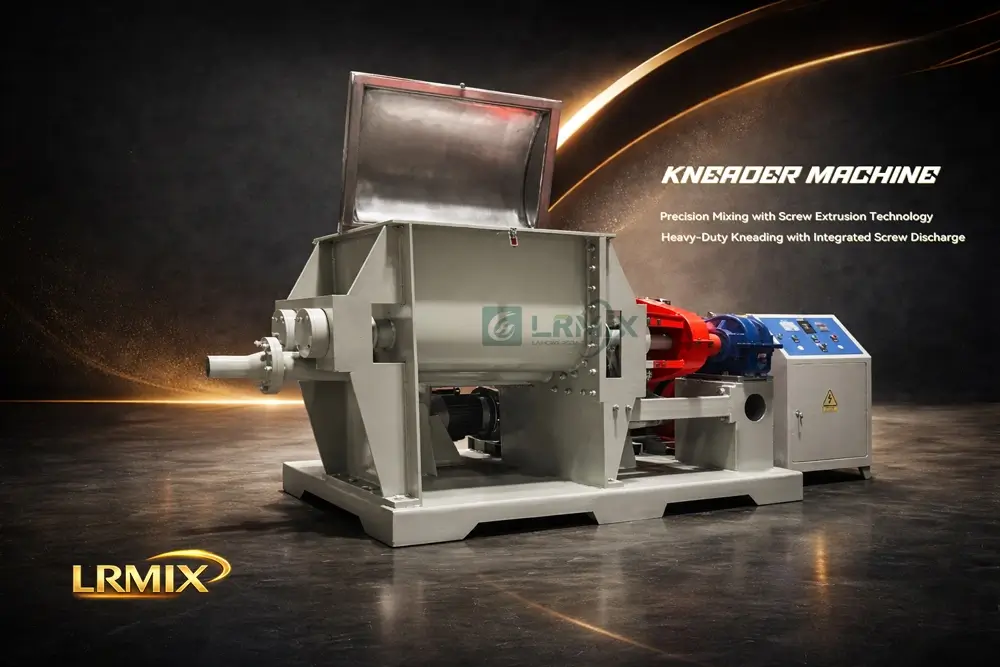
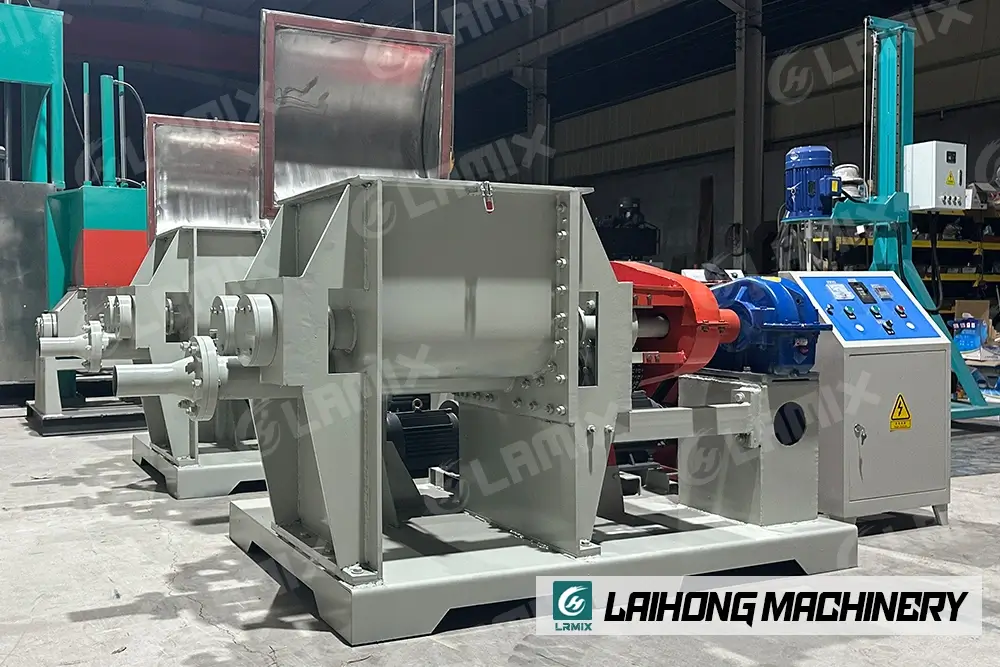
This is the LRMIX 100L Screw Extrusion Sigma Kneader. Here is why the discharge method matters — and why this configuration is the right choice for specific production requirements.
The Three Discharge Methods: What Each One Means in Practice
Sigma kneaders are available with three discharge configurations. Each has a different impact on production efficiency, operator safety and downstream process compatibility.
Hydraulic Tilt Discharge (130°) The vessel tilts hydraulically, compound flows out under gravity. Effective for most high-viscosity materials. Requires collection equipment — trays, moulds, conveyor — below the discharge point. Discharge time 3–5 minutes. Some manual assistance may be needed for very sticky materials.
Bottom Ball Valve Discharge A valve opens at the base of the vessel. Suitable for lower-viscosity compounds with adequate flow under gravity. Fast cycle time. Limited use with very high-viscosity or tacky materials that do not flow freely.
Screw Extrusion Discharge An integrated screw extruder is positioned below the kneading chamber. After mixing, the screw reverses direction and forces compound out through a discharge die as a continuous strip or pre-formed shape. The compound is extruded under positive pressure — it does not rely on gravity or material flow.
According to ROSS/AMK — one of the leading sigma kneader manufacturers in the United States — screw extrusion discharge reduces mixing time by approximately 15% compared to hydraulic tilt systems, because the screw continuously feeds material back into the blade zone during mixing as well as during discharge.
Why Screw Extrusion Is the Right Choice for Certain Applications
Silicone Rubber Compounding — High Volume Production
Fully compounded HTV silicone rubber is one of the most difficult materials to discharge from a kneader. It is elastic, extremely adhesive and resists flow under gravity. With hydraulic tilt discharge, some residue always remains in the vessel and on the blades — this material is either lost or must be scraped manually.
Screw extrusion eliminates this problem. The screw forces every gram of compound out through the die, with minimal residue. For silicone rubber producers running multiple batches per shift, this reduces material loss significantly over a production week.
More importantly, the screw extruder can discharge the compound directly onto a calender, into a granulator, or into downstream forming equipment — eliminating a manual handling step entirely.
Ceramic Clay Body Preparation
As documented by ceramic engineering specialists including Digitalfire Ceramic Materials Database, ceramic body preparation requires not just mixing but active compaction and de-airing. The screw extrusion discharge provides an additional compaction phase as the prepared body passes through the screw — producing a denser, more uniform extrudate compared to tilt discharge.
For technical ceramics and oxide ceramics where body density and homogeneity directly affect sintered properties, this additional processing step has measurable value.
Operator Safety — Elevated Temperature Materials
When processing materials at elevated temperatures — hot melt adhesives, heated ceramic bodies, carbon electrode paste — manually handling the discharged compound from a tilt-discharge kneader exposes operators to burns and contact with potentially hazardous materials.
Screw extrusion contains the discharge process entirely within the machine. The operator does not contact the material during discharge. This is a genuine safety improvement, not a marketing point.
What This Machine Is — and What It Is Not
This 100L unit is a single-layer vessel with no heating jacket and no vacuum system. This is an important specification point.
No heating jacket means: this machine processes materials at ambient temperature, or materials that are pre-heated externally before loading. It is not suitable for applications requiring temperature control during the mixing cycle.
No vacuum system means: this machine does not degas the compound during mixing. It is not the correct choice for applications where air entrapment in the finished compound causes product defects — medical-grade silicone, void-sensitive optical applications, or technical ceramics where vacuum degassing is specified.
For silicone rubber producers who manage temperature externally and whose product specification does not require vacuum degassing — this is the correct, cost-effective configuration. Adding heating and vacuum where they are not needed increases capital cost, maintenance complexity and failure points without process benefit.
Technical Specifications
| Parameter | Specification |
|---|---|
| Effective Volume | 100 Litres |
| Blade Type | Sigma Z-blade, Counter-Rotating, Differential Speed |
| Discharge Method | Screw Extrusion |
| Vessel Jacket | Single layer — no heating or cooling |
| Vacuum System | Not included |
| Vessel Material | Carbon Steel (standard) |
| Certification | CE |
| Custom Options | Heating jacket, vacuum, SS304, larger capacities available |
Suitable Applications
This 100L screw extrusion sigma kneader is used for:
Silicone rubber (HTV) compounding — high-volume batch production feeding calender or granulator lines
Ceramic clay body preparation — traditional pottery, stoneware, industrial ceramics requiring homogeneous extrudate
Carbon paste and electrode compounds — carbon black, graphite-based formulations for battery and electrode applications
Adhesive base compounds — structural adhesives and sealant bases processed at ambient temperature
Rubber compounds — general industrial rubber mixing where continuous strip output is required
Chewing gum and confectionery — gum base preparation where the screw feeds downstream forming equipment directly
Screw Extrusion vs Hydraulic Tilt: Which Is Right for Your Production?
| Factor | Screw Extrusion | Hydraulic Tilt |
|---|---|---|
| Discharge mechanism | Active — screw pressure | Passive — gravity |
| Residue | Minimal | More residue for sticky materials |
| Operator contact with material | None | Some manual assistance may be needed |
| Downstream integration | Direct feed to calender / granulator | Requires collection equipment |
| Mixing efficiency | ~15% faster cycle (ROSS/AMK data) | Standard |
| Capital cost | Higher | Lower |
| Best for | High-volume, sticky materials, line integration | General batch production |
View Product Page
Full specifications and enquiry
Related Application Guides
Silicone Rubber Kneader Machine
Ceramic and Clay Mixer Kneader
About LRMIX
LRMIX is the international brand of Shandong Laihong Machinery Equipment Co., Ltd — sigma kneader and industrial mixer manufacturer with over 15 years of production experience, supplying customers in 40+ countries across Southeast Asia, the Middle East, South Asia, Europe and the Americas.
Email: info@lrmixer.com
Website: lrmixer.com